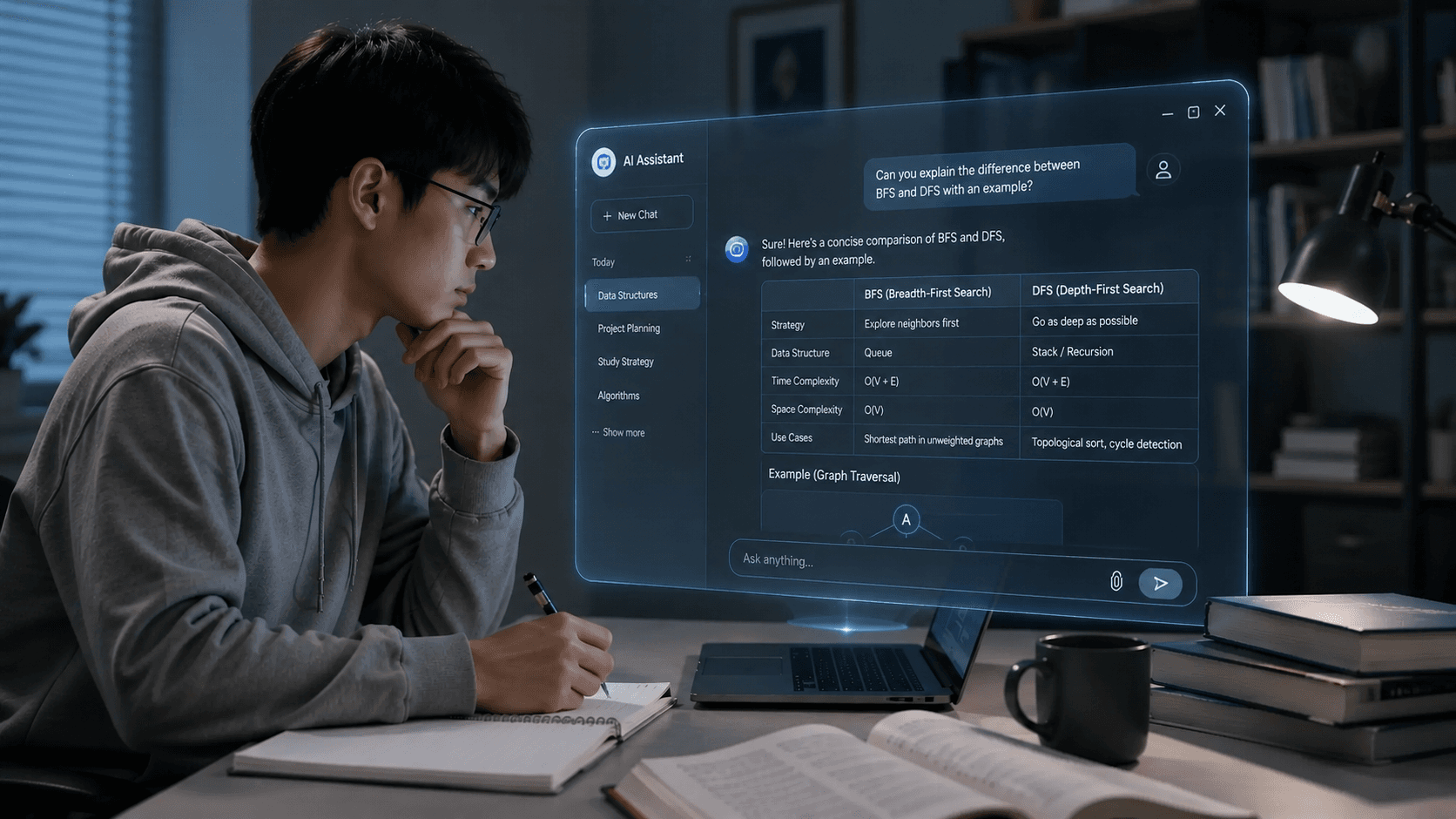
AI is more than just a tool — it's your 24/7 teacher when it comes to study

For students, AI is no longer only a search engine or a writing assistant. Used carefully, it can become a patient teacher that is available whenever confusion appears.
I am a Master's student at Northeastern University, and the rapid advancement of AI has changed the way I study. A few years ago, learning usually meant relying on textbooks, my own notes, lecture slides, and online video lectures. These resources were useful, and often enough to help me pass exams or complete assignments. But they had limits. A textbook does not know which sentence confused me. A recorded video cannot redesign its explanation around my misunderstanding. My notes could remind me what the professor said, but they could not always help me rebuild a shaky concept.
During my undergraduate years, I often felt that my review process lacked focus. I could spend hours reading chapters or watching videos and still not know whether I truly understood the material. Sometimes I remembered the surface of a concept but not the reasoning behind it. Sometimes I could solve a familiar problem but failed when the same idea appeared in a different form.
Now, with tools like ChatGPT, Gemini, and Claude, my learning process has become much more active. I do not treat AI as a shortcut that replaces studying. Instead, I use it as a 24/7 teacher: something I can question repeatedly, ask for examples, challenge, and use to check my understanding. The real difference is interaction. AI gives me a way to turn passive review into a conversation.
One clear example is the Data Structures course I studied last semester. I had already learned data structures as an undergraduate, so the topic was not completely new to me. However, my foundation was shaky. Some concepts were familiar but unclear, and others had simply been forgotten. I remembered terms like stack, queue, tree, graph, heap, and hash table, but remembering names was not the same as understanding tradeoffs, implementation details, or use cases.
To fix this, I built a small knowledge base for myself. I collected class materials, notes, definitions, sample problems, and the concepts I repeatedly confused. Then I used ChatGPT and Gemini to clarify distinctions between similar ideas. For example, I could ask them to compare arrays and linked lists, binary search trees and heaps, BFS and DFS, or hash maps and balanced trees. Instead of only giving definitions, they could explain differences through examples, time complexity, memory behavior, and practical scenarios.
This helped me identify gaps earlier. If I did not understand an answer, I could immediately ask for a simpler explanation, a diagram-like description, or a coding example. If the explanation seemed too general, I could ask for edge cases. If I thought I understood something, I could ask AI to quiz me. That back-and-forth is difficult to get from static study materials.
Before exams, I also used AI to generate practice questions based on sample problems. This changed the way I reviewed. In the past, I sometimes reviewed aimlessly, rereading notes without knowing whether I was improving. Now I can ask the model to produce questions at different difficulty levels, solve them myself, and compare my reasoning with the explanation. This gives me a clearer sense of my proficiency and exposes whether I only memorized a pattern or actually understood the concept.
For course projects, I use Claude in a slightly different way. Claude is helpful for planning, organizing, and turning a large project into a manageable schedule. I can give it the project requirements and ask for an outline, milestones, risks, and a weekly plan. As the project progresses, I adjust the plan incrementally. This helps me avoid doing too much at the last minute.
Claude is also useful for presentation preparation. Based on my project details, it can generate a complete slide structure, suggest what each slide should cover, and help organize the story of the project. This saves time on tedious formatting work such as adjusting font sizes, rewriting slide titles, and deciding how to present each section. More importantly, it lets me focus on whether the project logic is clear.
AI does not remove the need to think. It makes the thinking process more visible, more interactive, and easier to test.
Of course, students still need judgment. AI can make mistakes, misunderstand course requirements, or explain something too confidently. For technical subjects like Data Structures, I still verify answers with lecture materials, textbooks, documentation, or actual code. Even with that limitation, AI has become one of the most powerful learning tools I use.
This is just one example from my own experience, but it shows a broader transformation in education. AI is changing personal learning from a one-way process into an interactive system. It can explain, quiz, organize, plan, and help students reflect on what they do not know. For me, AI is more than just a tool. When used responsibly, it becomes a teacher that is always available, always patient, and always ready for the next question.

Tom Wang
Master's Student, Northeastern University
MS ECE concentrated in Computer Vision, Machine Learning, and Algorithms, Graduate Student from Northeastern University, Boston. Have a strong interest in software development, Artificial Intelligence/Machine Learning research, and algorithm studies. Participated in related projects and internships such as data analysis using ML methods, machine learning driven algorithms, large model deployment & fine-tuning and multimodal content defense research.

Max Li
Founder, Grassrootech
max@grassrootech.comMax is dedicated to bridging the gap between advanced research and practical industry application. Drawing on his experience at IBM Research and Union University, he leads the development of AI solutions that drive meaningful progress.
Read More

What Should You Do If You Have Used Up Your Quota for OpenAI Codex?
OpenAI Codex is excellent, but quota limits are real. Here is a practical fallback strategy for developers who want to keep building without jumping immediately to a more expensive plan.

Have you heard of OPC: One Person Company?
AI is making a new kind of company imaginable: one person coordinating agents, software, and distribution with the leverage of a much larger team.